Wednesday, October 13, 2010

Creative Embroidery

Members of  Form II have begun work on the art of Creative Embroidery. Their brief is to create a landscape scene using any variety of materials suitable for stitching. Embroidery is the art or handicraft of decorating fabric or other materials with needle and thread or yarn. Embroidery may also incorporate other found materials such as plastics, paper, metal strips, pearls, beads, and sequins.
Embroidery is one of the craft options for the Junior Certificate Project ans should any of the Form II pupils choose this as an option next year, a sewing machine will also be made available to them.


Marina Pollock

Arthur Moffitt

Rowland FitzGerald Barron

Antonia Esses

Daniel Lalor

Edward Tottenham

Saturday, October 9, 2010

Down on the Farm

Form V have begun to explore the various aspects of the Leaving Certificate Craft Paper. Posted below are a number of images showing work in progress based on the craft Batik . The theme of the question is 'Down on the Farm'. It is interesting to note the various interpretations of the question especially given that for some pupils this is the first batik that they have ever done. For the Leaving Certificate Batik Question, pupils are required to complete their batik with at least two full dips (dyes can also be applied by sponge) and to create a number of cracking veining textures. The finished batiks will be posted here in the coming weeks.

 Jonathan Shiell


Angus Johnson


 Tyrone Langham


Alex von Buelow


Fenia Miescke


Ciara O Byrne


Friday, October 8, 2010

Form I Lino-Prints


Clara Murphy


Caroline Kavanagh


Marina Wright

Thursday, October 7, 2010

Form I Lino-Prints

Janet Boyd

Michael Murphy

Wednesday, October 6, 2010

Form I Lino-Prints

Form I have completed their Lino-Prints with some great results. They managed to achieve some strong textures even though they were just using house-hold kitchen floor lino. Examples of their work will be posted here over the next few days.


Simon Glennon


Ciaran Chisholm

Friday, October 1, 2010

Figure Painting

Form Primary have been working on figure painting over recent weeks. These life size paintings show great imagination and attention to detail. The exercise helps the pupils to understand complexities such as proportion, shape and form, all of which are necessary elements of figure drawing.

Wednesday, September 29, 2010

Form VI Craftwork

Form VI are working on the Craft Section of the Leaving Certificate Art Paper at the moment. Posted today are some excellent examples of clay modelling craft work by Imogen Wardell and Daniel Roden. Both pieces are works in progress and the finished glazed models will be
posted here in coming weeks.


                       Daniel Roden


Imogen Wardell

Friday, September 24, 2010

Positive & Negative

Form I have now completed the papercutout portraits they began last week. Their exploration of the elements positive and negetive continued with the creation of images on black paper using house-hold bleach. 


Andrew Brady                                       Form I

Janet Boyd                                              Form I

Ciaran Chisholm                                      Form I

Thursday, September 23, 2010

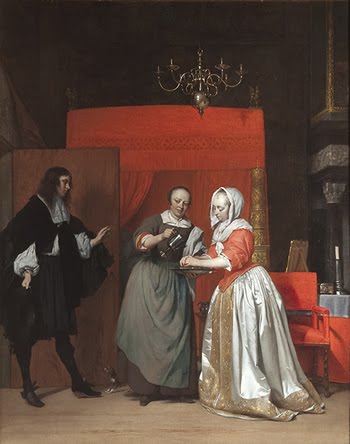
Gabriel Metsu

Today,  Senior Cycle pupils studying art will visit the Gabriel Metsu Exhibition at the National Gallery Dublin.

Born in 1629 to a painter and a midwife, Metsu was recorded as a painter at the tender age of 14. The name of his teacher is unknown, but he probably studied for some time under the Utrecht painter Nicolaus Knupfer. In Leiden, Metsu painted mainly large-scale biblical scenes.

In the middle of the 1650s, after his parents had died, Metsu moved to Amsterdam. This shift prompted him to change his specialisation and paint intimate scenes of daily life inspired by Gerrit Dou from Leiden and Gerard ter Borch from Deventer. As Metsu’s style became more meticulous in the 1660s, he focused increasingly on representing the pastimes of the upper class. Towards the end of his life, when he was one of the leading genre painters in Amsterdam, he continued to compete with various contemporaries outside his hometown, including Johannes Vermeer from Delft and Frans van Mieris from Leiden.

Metsu had an unrivalled talent for imbuing his figures with humanity and personality. Few of his contemporaries matched his technical virtuosity.

In 1658 Metsu married Isabella de Wolff, daughter of Maria de Grebber, one of Holland’s few female painters and a member of the well-known artistic De Grebber family from Haarlem.

Wednesday, September 22, 2010

Chapel Art Project


Form VI Q Set are continuing with their Chapel based project and today they began the process of turning their research work into mood boards.  These are essentially  collages of all their research work including photos, drawings and rubbings.  These mood boards will provide the inspiration for their group-work project.